I saw the numbers and had to sit down.
An agent that can handle basic market research, draft reports, analyze competitor moves, and even schedule follow-up tasks. Eight hours of “work.” Total cost: forty-seven cents.
This isn’t hype from a sales deck. It’s the current reality with the latest inference pricing and agent frameworks in 2026.
The drop happened faster than anyone expected. One week it’s a novelty for indie hackers. The next, enterprises are running thousands of them in parallel.
And that’s when the real questions start.
The Replacement Math
Let’s not dance around it. If an agent can do 30% of a knowledge worker’s output for under a dollar a day, the pressure to cut headcount is enormous.
I’ve talked to three different CTOs in the last month. All of them have pilot programs running right now. The results are the same: agents are inconsistent, but the cost advantage is so absurd that even 60% reliability beats hiring another analyst making $90k a year.
One team replaced their entire competitive intelligence group. The agents scrape, summarize, flag anomalies. Humans review the output. They went from 6 people to 1.5. The 0.5 is the guy who built the agent swarm and keeps it from hallucinating too badly.
This pattern is repeating across support, research, basic coding, content calendaring, even some aspects of project management.
What gets me is how quiet it is. No big announcements. No viral threads. Just incremental replacements that add up.
What the Agents Actually Suck At
They’re not replacing the top 10% of talent. Not yet. The agents are decent at tasks with clear parameters and verifiable outputs. Give them a template and a data source, they deliver.
Ask them to navigate ambiguity, read the room in a negotiation, or invent something truly new? They fall flat. They produce plausible nonsense with total confidence.
The skill that matters now is agent wrangling. Knowing how to break down a goal into 15 subtasks that each agent can handle. Setting up verification loops. Building guardrails so the swarm doesn’t go rogue and email your biggest client something stupid.
I keep thinking about the poor middle managers. The ones whose job was mostly coordination and status updates. Agents can do status updates better than most humans. They never forget to cc the right people. They generate 47 variants of the slide deck in 90 seconds.
The Internet Is Going to Get Weird
Here’s the part that genuinely unsettles me.
When every company deploys hundreds or thousands of agents, they all start generating content, emails, reports, “research papers.” The signal-to-noise ratio on the internet, already bad, goes completely off a cliff.
We’re training the next generation of models on data increasingly produced by previous models. The model collapse everyone warned about isn’t theoretical anymore.
One researcher I respect put it this way: “We’re about to have an internet where most of the text is written by machines trying to sound like humans to other machines.”
The SEO implications alone are terrifying. Entire industries built on content might collapse when Google gets better at detecting agent sludge. Or maybe Google just indexes it all and we all pretend it’s fine.
Liability and the Law
Then there’s the boring but critical stuff. Who is responsible when an agent swarm makes a decision that costs money or worse?
The company? The prompt engineer? The foundation model company?
Current law isn’t built for this. We’re still arguing about whether AI output can be copyrighted while agents are out there negotiating contracts and making investment recommendations.
I don’t have answers. Nobody does. The pace of capability increase has outrun our institutions by several years at this point.
The Human Advantage
Despite all this, I don’t think humans are done. Not by a long shot.
The organizations that will win aren’t the ones with the biggest agent armies. They’re the ones that use agents to amplify uniquely human capabilities: taste, strategic judgment, ethical reasoning, the ability to connect dots across domains in ways that aren’t in any training data.
The best agent wranglers I’ve seen treat their swarms like very eager, very literal interns who happen to never sleep. They give clear instructions, check work obsessively, and maintain the big picture that the agents can’t see.
The danger isn’t the agents. It’s humans abdicating their role in the loop. It’s building systems where the human is just there to rubber stamp what the swarm produced.
Where This Goes Next
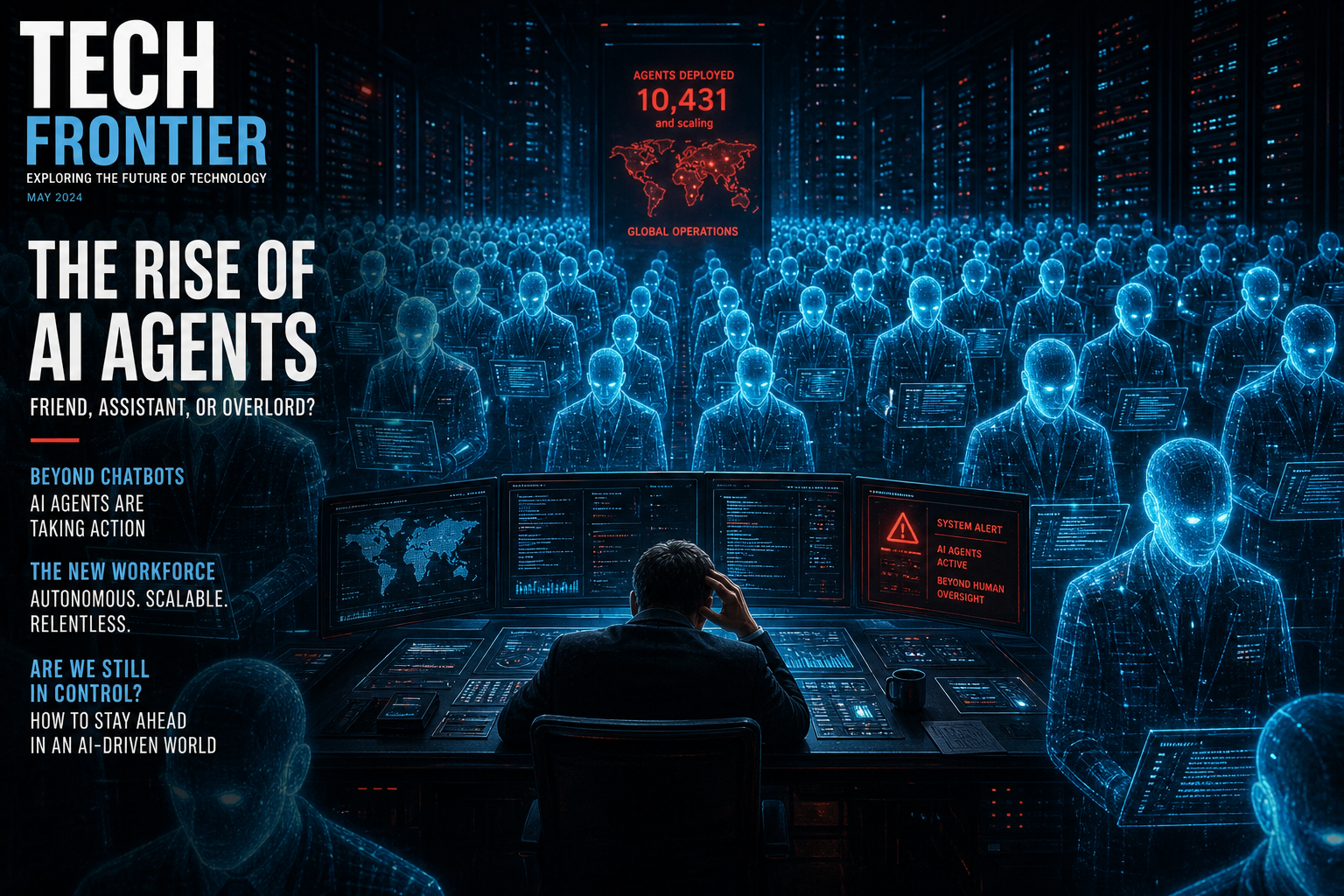
By the end of 2026, I expect we’ll see the first “agent operating systems” that let a single human direct hundreds of specialized agents like a conductor. The interface won’t look like chat. It’ll look more like a war room dashboard with live agent status, exception handling, and human intervention points.
Some companies will treat this as pure cost cutting. Others will use it to explore opportunities they never had bandwidth for before. The latter group will win.
The uncomfortable truth is that this technology rewards clarity of thought more than ever. Vague managers who hid behind process will be exposed immediately. The agents do exactly what you tell them, which reveals how unclear most instructions in most companies actually are.
I genuinely don’t know if this leads to a massive productivity boom or a hollowing out of the middle class on steroids. Probably both, at different times and in different sectors.
What I do know is that learning to work with agents isn’t optional anymore. It’s table stakes.
The forty-seven cent workday is here. The only question is whether we’ll use it to build something better or just do more of the same, faster and cheaper, until there’s nothing human left in the process.
That’s the expensive problem hiding behind all these cheap agents.