On April 27, 2026, OpenAI didn’t just announce a product. It announced a strategy—one that could redraw the power lines of the entire tech industry.
In the span of a single Monday, two stories broke that, taken together, reveal what OpenAI actually wants to be. Not a chatbot company. Not an API provider. A full-stack platform that touches every layer of the computing stack—from the data center to the chip to the device in your pocket.
Story One: The Microsoft Deal Gets Rewritten
OpenAI and Microsoft announced an amended partnership agreement that fundamentally restructures their five-year alliance. The headline is simple: OpenAI now has the green light to work with Amazon Web Services and other cloud providers without tripping over Microsoft’s exclusivity rights.
The subtext is more important.
Microsoft has invested roughly $13 billion into OpenAI and built its entire Copilot strategy around exclusive access to GPT models. That exclusivity just got diluted. OpenAI can now sell its models through AWS, Google Cloud, or any other provider it chooses—turning its models into a cloud-agnostic commodity rather than a Microsoft exclusive.
Why would Microsoft agree to this? Because the alternative was worse. OpenAI’s growth trajectory is now so steep that restricting it to Azure would have created enough tension to fracture the partnership entirely. By renegotiating, Microsoft keeps OpenAI close while conceding the inevitable: GPT-class models are becoming infrastructure, and infrastructure can’t be locked to a single vendor.
“OpenAI has the green light to work with Amazon or any other cloud provider, though there are some strings attached.” — Business Insider, April 27, 2026
The deal also clarifies what happens when OpenAI hits Artificial General Intelligence (AGI). Under the old agreement, Microsoft’s exclusive rights would terminate once OpenAI achieved AGI—a clause that created perverse incentives for OpenAI to delay declaring AGI in order to keep the money flowing. The new agreement removes that tension, though the exact terms remain private.
Story Two: The AI Phone That Replaces Apps
Hours after the Microsoft news broke, supply-chain analyst Ming-Chi Kuo—the same analyst famous for nailing Apple hardware leaks years ahead of launch—published a report claiming OpenAI is developing a smartphone in partnership with MediaTek, Qualcomm, and manufacturer Luxshare.
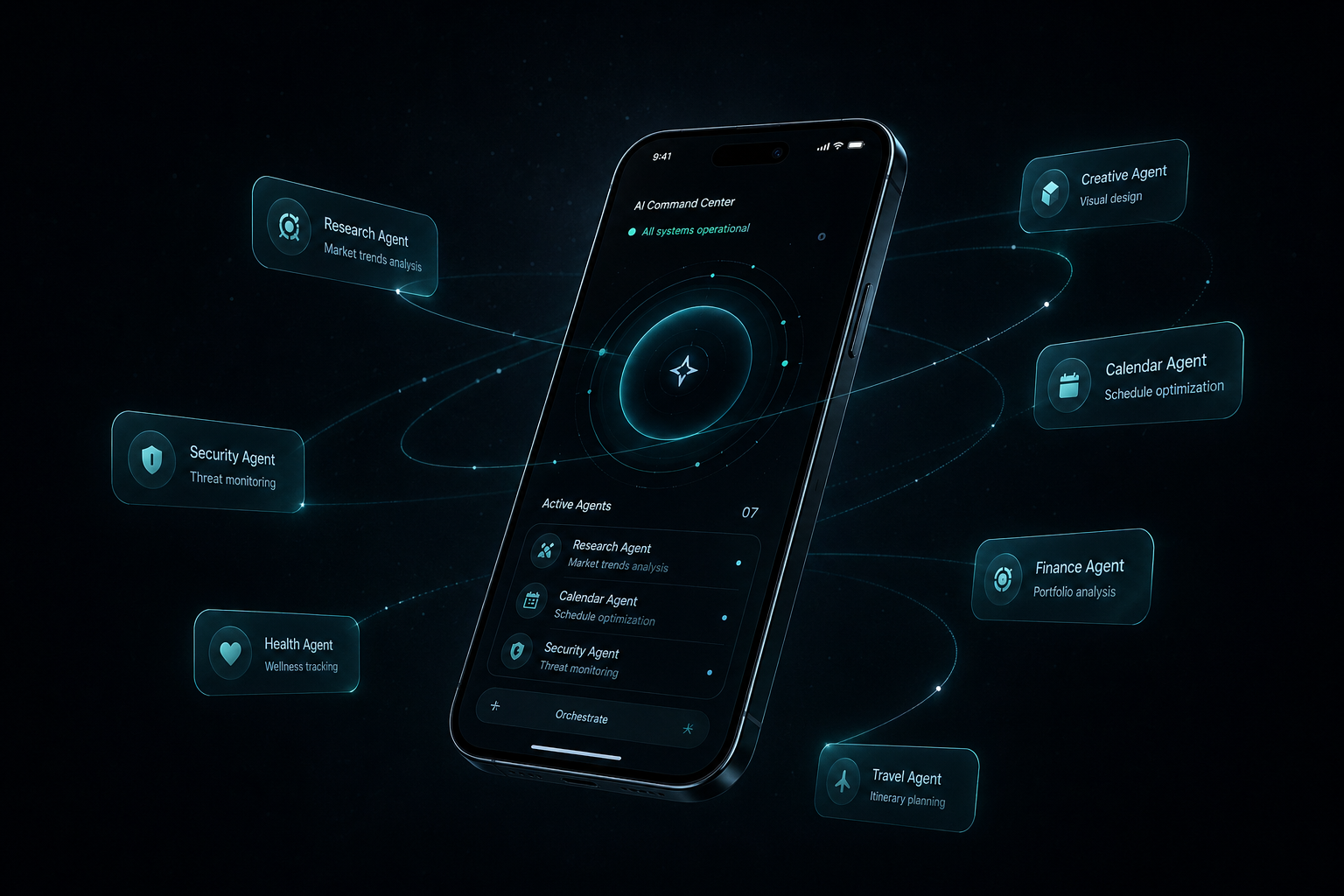
The device’s premise is radical: AI agents replace traditional apps.
Instead of opening Instagram, Uber, or Spotify, you tell your phone what you want—“show me what my friends are doing,” “get me home,” “play something I haven’t heard”—and an agent orchestrates the task across services without surfacing the apps themselves. The phone becomes a context-aware interface layer, with OpenAI’s models running both on-device (via small local models) and in the cloud.
The motivation is clear. Right now, Apple and Google control the app ecosystem. They take their 30% cut. They restrict system-level access. They gate what AI features can and can’t do on their platforms. By building its own hardware stack, OpenAI bypasses all of it.
“By creating its own smartphone and hardware stack, OpenAI would be able to use AI in all kinds of features without restrictions.” — Ming-Chi Kuo, via TechCrunch
The timeline, if Kuo’s sourcing holds, looks like this:
| Milestone | Target Date |
|---|---|
| Component specs and suppliers finalized | Q1 2027 |
| Earbuds (first hardware product) announced | H2 2026 |
| Smartphone mass production begins | 2028 |
ChatGPT is already approaching one billion weekly users. A phone gives OpenAI a direct channel to those users that no app store gatekeeper can tax, throttle, or reject.
Why These Two Stories Are Actually One Story
Taken separately, each story is significant. Taken together, they describe a platform play that mirrors the most successful tech companies of the past two decades.
Apple owns the silicon (A-series chips), the operating system (iOS), the services layer (App Store, iCloud), and the device (iPhone). That vertical integration is why Apple captures the majority of smartphone industry profits despite having a minority market share.
Google owns the data center infrastructure (GCP), the model layer (Gemini), the services layer (Search, Maps, YouTube), and the device layer (Pixel, Android). It doesn’t own all of it perfectly, but it touches every layer.
OpenAI is now trying to build the same structure. The models (GPT-5.5 and beyond) are the operating system. The cloud deals (Microsoft, AWS, and eventually others) are the data center layer. The phone and earbuds are the device layer. And the agents that replace apps? That’s the services layer.
| Stack Layer | Apple’s Equivalent | OpenAI’s Play |
|---|---|---|
| Silicon | A-series / M-series | Partnerships with MediaTek, Qualcomm |
| Cloud / Data Center | iCloud / Private Cloud | Microsoft Azure + AWS + future providers |
| OS / Model | iOS / macOS | GPT models as the “AI OS” |
| Services | App Store, iCloud, Apple Music | AI agents replacing apps |
| Device | iPhone, Mac, AirPods | Smartphone (2028), earbuds (2026) |
The model isn’t just competitive with Apple and Google. It’s structurally designed to make their moats irrelevant. If users interact with services through an AI agent rather than through apps, the App Store becomes a backwater. If the phone’s intelligence comes from OpenAI’s cloud, the operating system becomes a thin client.
The Agentic Premise
The “agents replace apps” idea isn’t coming from nowhere. At SXSW 2026, Nothing CEO Carl Pei publicly predicted that apps will eventually go away as AI agents take over task completion. The “vibe coding” movement is already building software without traditional interfaces. And OpenAI’s own research has increasingly focused on agentic systems that can browse, book, buy, and compose across the web without human micromanagement.
The bet is that users don’t actually want apps. They want outcomes. And if an AI agent can deliver those outcomes faster, more contextually, and with less friction than tapping through five different interfaces, the apps become invisible infrastructure—pipes behind the wall, not faucets in the kitchen.
Of course, that future depends on trust. An agent that books your flights, orders your groceries, and messages your friends on your behalf needs permissions that current app architectures deliberately restrict. OpenAI’s answer to that tension is simple: own the hardware. If you control the device, you control the permission model.
The Competitive Response
Apple and Google are not sitting still. Apple’s Apple Intelligence is embedding on-device models across iOS, and its private cloud compute architecture is designed to keep user data away from third-party AI providers. Google’s Gemini is being woven into Android at the system level, and its Tensor chips are purpose-built for on-device inference.
But both incumbents face a structural problem. Their business models depend on the app ecosystem. Apple Services revenue—which includes the App Store, Apple Pay, and subscriptions—generated over $85 billion in 2025. Google earns billions from Play Store commissions and mobile search ads tied to app usage. Neither company can afford to kill the app without cannibalizing its own revenue.
OpenAI has no such constraint. It has no App Store to protect. No 30% commission to preserve. It can build the agent-first future because it has nothing to lose in the old world.
What to Watch Next
If OpenAI is serious about the full-stack play, these are the signals to track over the next 18 months:
1. Chip partnerships. MediaTek and Qualcomm are named in Kuo’s report, but custom silicon is where the real leverage lives. If OpenAI follows Apple’s path and designs its own AI accelerators, the competitive gap widens dramatically.
2. Cloud pricing wars. OpenAI’s multi-cloud strategy means AWS and Microsoft will compete to host its inference workloads. Watch for pricing announcements that undercut each other—those discounts are subsidies for OpenAI’s margin expansion.
3. Regulatory scrutiny. A phone that replaces apps with agents raises antitrust questions before it even ships. If the EU’s Digital Markets Act applies to AI agents the way it applied to app stores, OpenAI could face the same gatekeeper regulations it’s trying to escape.
4. The developer exodus. If OpenAI’s agents disintermediate apps, what happens to the millions of developers who built their businesses on the App Store? Some will build agents instead. Others will fight the transition politically and legally. The backlash could be fierce.
The Forward-Looking Takeaway
For the past three years, the AI race has been about models—who has the biggest context window, the best benchmark score, the lowest hallucination rate. That race isn’t over, but it’s becoming table stakes.
The next race is about platforms—who controls the interface between humans and the digital world. OpenAI’s April 27 announcements signal that it intends to compete not as a model vendor selling to Apple and Google, but as a platform owner competing with them.
Whether it succeeds depends on execution. Building a phone is hard. Building an ecosystem is harder. And convincing users to abandon the app paradigm they’ve used for fifteen years is harder still.
But if OpenAI pulls it off, the company won’t just be the most important AI lab in the world. It’ll be the most important computing company—full stop.
The model wars are ending. The stack wars have begun.