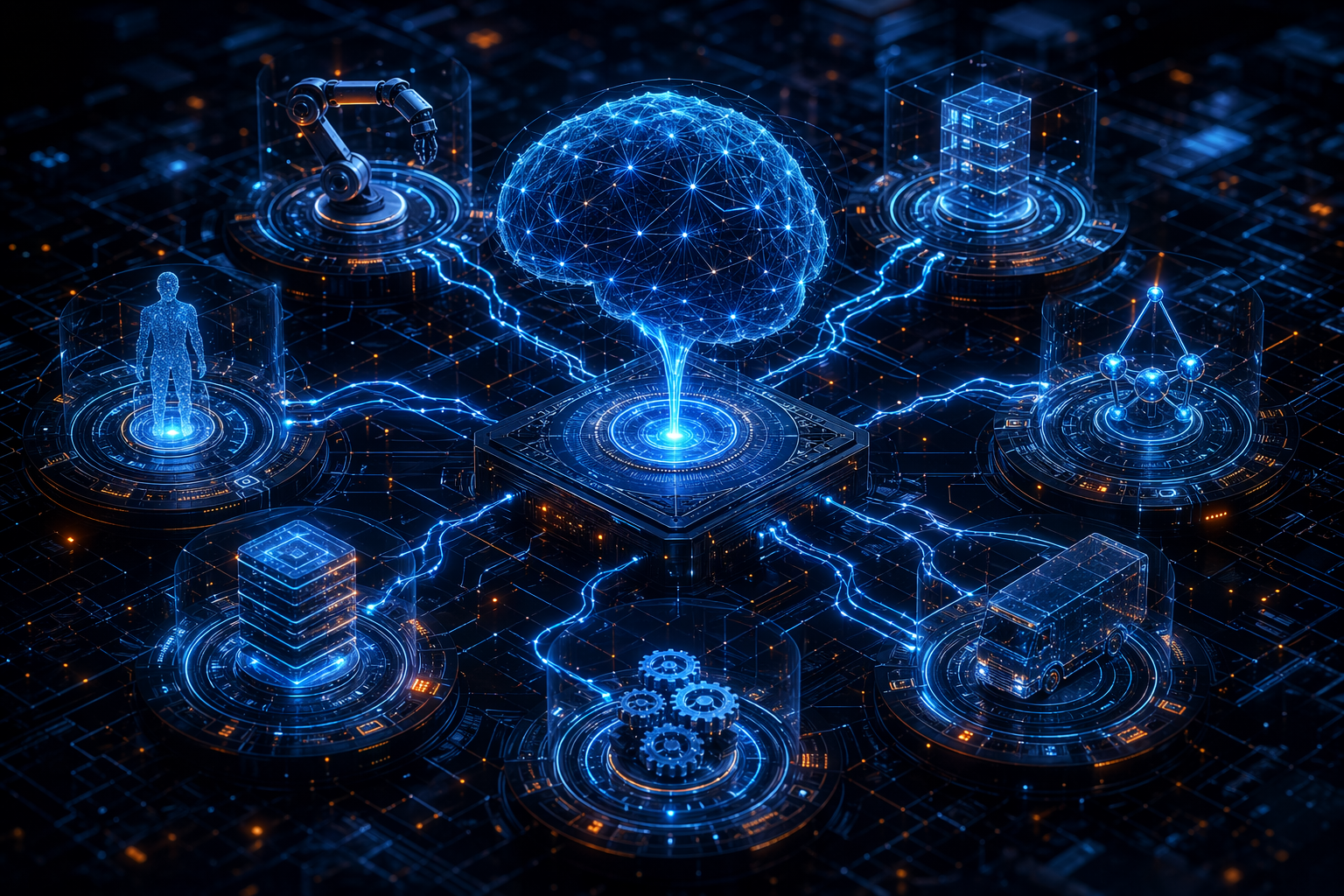
The highest-leverage skill in AI engineering has shifted. Prompt engineering—the art of coaxing a single response from a large language model—is still useful, but it is no longer the ceiling. What matters now is flow engineering: designing control flow, state transitions, and decision boundaries around LLM calls. We are building systems that think in loops, not lines.
This is the agentic paradigm. And in 2026, it has moved decisively from research curiosity to production necessity.
Generative vs. Agentic: The Divide
Generative AI answers questions. Agentic AI pursues goals.
If you ask a generative model to “draft a marketing email,” it produces text and stops. Ask an agentic system to “increase newsletter engagement by 15% this quarter,” and it will analyze segments, draft variants, run A/B tests, interpret results, and iterate on its own. The difference is not better prompting. It is a fundamentally different architecture: one of autonomy, memory, tool-use, and feedback loops.
This distinction reshapes everything from failure modes to infrastructure. A wrong answer from a chatbot is embarrassing. A wrong action from an autonomous agent—issuing a refund, deleting a database, sending an email—has consequences.
The Five Core Modules
Every production-grade agentic system is built from five essential modules. You will find these everywhere, whether you are using LangGraph, CrewAI, or building from scratch.
1. Perception
The perception module transforms raw inputs—user messages, API responses, sensor streams—into structured information. This ensures that reasoning is grounded in observed data rather than model hallucination. Without it, your agent is a person with their eyes closed.
2. Planning
Complex objectives are decomposed into executable subtasks. Modern systems use hierarchical decomposition, often structured as directed acyclic graphs. The planning module decides not just what to do, but in what order, and when to parallelize versus when to sequence.
3. Memory
Memory is the biggest unlock and the biggest challenge. Production systems implement three distinct layers:
- Episodic memory: Specific events with rich context, stored in vector databases for semantic retrieval.
- Semantic memory: Distilled patterns extracted from episodic experience.
- Procedural memory: Learned execution routines that reduce reasoning overhead.
Importantly, strategic forgetting is as critical as remembering. Older episodes should compress into semantic summaries, while recent context maintains high fidelity.
4. Action
This is the module that reaches out into the world. It invokes APIs, queries databases, schedules meetings, and executes code—with guardrails. Every action should pass through an allowlist, schema validation, authorization checks, and rate limiting. The agent must be capable but constrained.
5. Feedback
The feedback module closes the loop. It evaluates outcomes, modifies strategy, records experiences back into memory, and enables graceful degradation when components fail. Without feedback, the agent never learns. It simply repeats.
The Six Canonical Patterns
Frameworks change. Patterns persist. Here are the six design patterns you should know, ranked from lowest to highest complexity.
| Pattern | Complexity | Primary Use Case |
|---|---|---|
| Reflection | Low | Self-correction and quality refinement |
| Tool Use | Low-Medium | External API and database integration |
| Planning | Medium | Multi-step task decomposition |
| Multi-Agent | High | Complex distributed workflows |
| Orchestrator-Workers | High | Dynamic subtask delegation |
| Evaluator-Optimizer | Medium-High | Quality-critical output pipelines |
Production systems routinely compose two or three of these together. An orchestrator-worker setup might layer in reflection loops on each worker’s output, while each worker uses tool-calling to ground its reasoning in real data.
Reflection
The simplest pattern, but surprisingly powerful. The agent generates output, evaluates it with a critique or score, and revises until a quality threshold is met. In practice, two to three iterations delivers the bulk of the improvement. Cap iteration counts and track token budgets to prevent infinite loops.
Tool Use
The four-phase cycle—define schemas, let the LLM select and parameterize, invoke the tool, integrate results—is the foundation of grounded agent behavior. When your agent has access to more than about fifty tools, accuracy degrades due to context limits. The fix: embed tool descriptions and dynamically load only the top-k most relevant tools per query.
Planning (ReAct & Variants)
The ReAct pattern interleaves explicit reasoning traces with actions: Thought → Action → Observation → repeat. This is the backbone of multi-step problem solving and dramatically reduces hallucination because every claim is grounded in observed tool results.
Multi-Agent Coordination
When one model is not enough, you distribute cognition. Specialized agents handle perception, reasoning, memory retrieval, and action execution independently, coordinating through a shared state or message bus.
Protocols Are the New Plumbing
Two open protocols are defining how agents connect to the world—and to each other.
MCP: Giving Agents Arms and Eyes
Anthropic’s Model Context Protocol (MCP), launched in late 2024, is the USB-C for AI tool integration. It standardizes how models connect to data sources, APIs, file systems, and databases. Before MCP, connecting $N$ models to $M$ resources meant building $N \times M$ custom integrations. With MCP, all models speak one protocol to all resources.
Think of MCP as equipping individual agents with the tools and context they need to act intelligently.
A2A: Agents Talking to Agents
Google’s Agent2Agent Protocol (A2A), announced in April 2025 with over 50 industry partners (Salesforce, SAP, MongoDB, LangChain), standardizes how agents communicate and collaborate across enterprise systems. A2A is built on HTTP, SSE, and JSON-RPC—familiar tech stacks that integrate cleanly into existing infrastructure.
A2A operates through a few elegant concepts:
- Agent Cards: Public JSON documents at
/.well-known/agent.jsondescribing an agent’s capabilities. Like a machine-readable LinkedIn profile. - Tasks: Discrete work units with a defined lifecycle—
submitted,working,input-required, andcompleted. - Artifacts & Messages: Conversational turns and final structured outputs.
The two protocols are complementary, not competitive. MCP equips individual agents. A2A lets those agents work together. One gives your agent arms and eyes. The other lets it join a team.
Three Levels of Deployment Maturity
Not every workflow needs full autonomy. Most production systems today sit somewhere on this spectrum.
| Level | Decisions | Description |
|---|---|---|
| AI Workflow | Output only | The model decides what to generate, but the process is fixed. |
| Router Workflow | Output + Tasks | The model selects tools and routes through predefined paths. |
| Autonomous Agent | Output + Tasks + Process | Full control over flow, can modify its own process, and request human input when uncertain. |
Level three—true autonomous agents—is still emerging. Demos like Devin and BabyAGI push the frontier, but they are not yet reliable enough for unsupervised production use. The sweet spot today is Level Two: intelligent routing with robust guardrails and human-in-the-loop checkpoints.
Practical Deployment Today
What does this look like in practice?
Document intelligence pipelines use a meta-agent to coordinate specialized document agents, each handling Q&A and summarization within its own domain.
Customer support systems deploy a router agent that triages incoming tickets, delegates to research agents for knowledge retrieval, hands complex cases to specialized reasoning agents, and summarizes outcomes back to the user.
Software engineering agents orchestrate coding, testing, and review as discrete sub-agents, with reflection loops built into the review stage.
The common thread: specialized agents for specialized tasks, coordinated through shared state, with clear boundaries for when to escalate to humans.
The Bottom Line
Agentic design is not about building the smartest possible single prompt. It is about designing systems that can perceive, plan, remember, act, and learn. The primitives—reflection, tool use, planning, multi-agent coordination—are well understood. The infrastructure—MCP for equipping agents, A2A for connecting them—is standardizing. The frameworks—LangGraph, CrewAI, AutoGen—have reached production stability.
What remains is the hard work of architecture: defining state schemas, drawing decision boundaries, building memory systems that forget strategically, and creating feedback loops that actually teach the system something.
The frameworks will change. The patterns will persist. Invest in flow engineering now.